

You just got a notification—someone filled out your contact form. Water damage emergency. Needs help ASAP.
You’re on a job site. Phone’s in the truck. You’ll call them back in an hour, maybe two.
By the time you do? They’ve already booked with someone else.
Sound familiar? You’re not alone. And it’s costing you way more than you think.
The Math That’s Killing Your Conversion Rate
Here’s what most restoration and home services contractors don’t realize: the speed of your response matters more than almost anything else when it comes to winning jobs.
The data is pretty brutal:
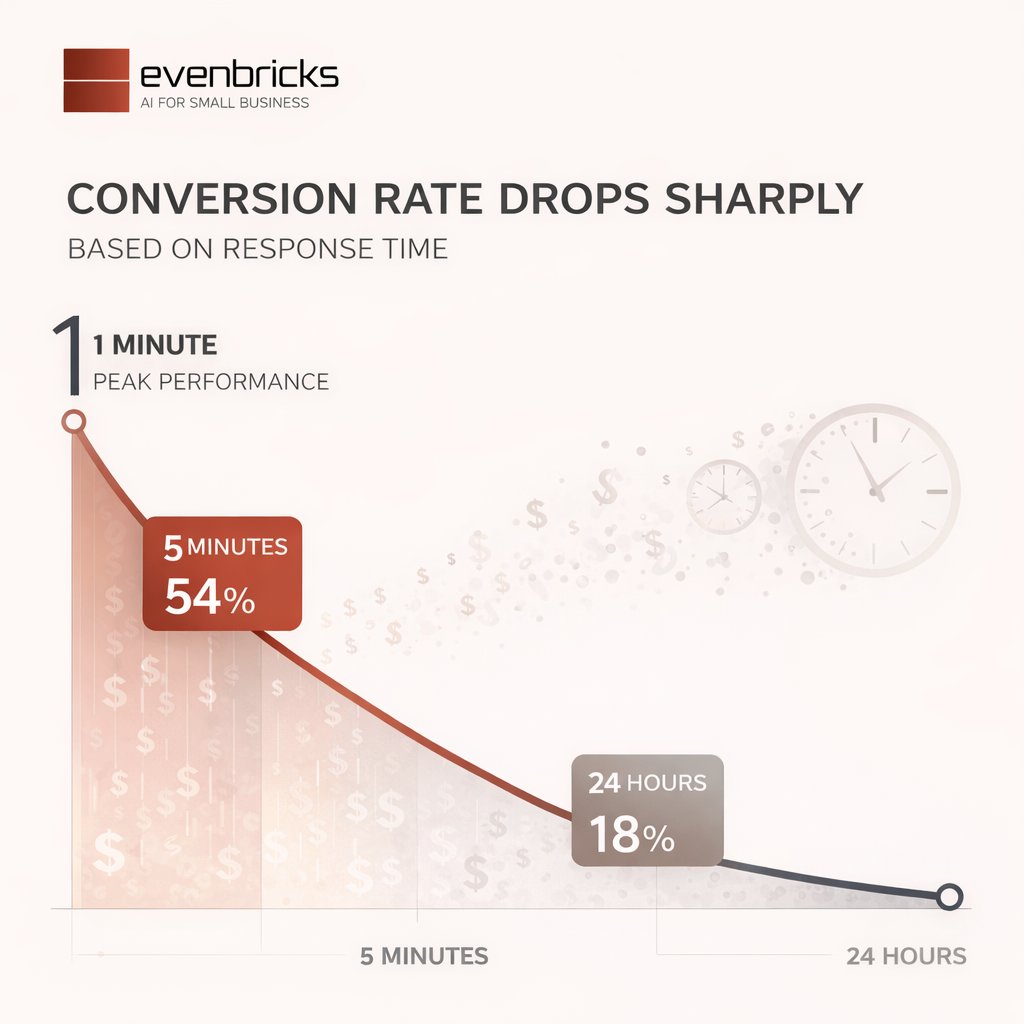
- Respond within 5 minutes: you’ve got about a 54% conversion rate
- Wait 24 hours: that drops to roughly 18% or less
- The first minute? Conversion rates jump by up to 391%
Think about that. More than half your leads convert when you respond immediately. Less than one in five when you wait a day.
In other words,tThat’s a 3x difference in how many estimates turn into actual booked jobs—just based on how fast you pick up the phone or send that first message.
What This Actually Costs You (Real Numbers)
Let’s run a quick scenario. Say you’re a restoration contractor doing around $2M annually:
- You get 50 leads per month from your website, Google LSA, referrals, whatever
- Your average job value is $3,500
- Right now, you’re converting maybe 20% of leads (pretty typical if you’re responding within a few hours)
That’s 10 jobs per month at $3,500 = $35,000 in monthly revenue.
However, now let’s say you could respond to every lead within 5 minutes instead:
- Same 50 leads
- But now you’re converting at 50% (because you’re actually fast)
- That’s 25 jobs per month at $3,500 = $87,500 in monthly revenue
The difference? $52,500 per month. $630,000 per year.
That’s not revenue you’re making—it’s revenue you’re losing because your competitors are faster than you.
Why You Can’t Keep Up (And Why That’s Not Your Fault)
Here’s the thing: you’re not slow because you’re lazy or bad at business. You’re slow because you’re busy actually doing the business.
You’re:
– Running job sites
– Managing crews
– Dealing with insurance adjusters
– Handling emergencies
– Ordering materials
– Doing estimates
Somewhere in there, you’re supposed to also be monitoring your phone, email, and website 24/7 so you can jump on every lead within 5 minutes?
Yeah, right.
Meanwhile, your competitors—especially the bigger operations—have office staff, answering services, or automated systems that capture and respond to leads instantly. Every. Single. Time.
They’re not better contractors than you. They’re just faster at the first response. And in today’s market, that’s often all it takes.
The Cold Estimate Graveyard
Response time isn’t just about new leads, either. What about all those estimates you sent that went cold?
You know the ones:
– Gave them a quote three weeks ago
– They said they’d “think about it”
– You meant to follow up but got slammed with emergency calls
– Now it’s been a month and it feels weird to reach out
There’s probably $30K-$50K worth of potential work just sitting in your sent folder or your CRM, slowly dying because nobody’s nurturing those conversations.
The contractors winning those jobs? They’re not forgetting. They’ve got automated follow-up sequences that keep the conversation going without them having to remember or find the time.
THE LEAD RESPONSE TIME SOLUTION (WITHOUT HIRING ANOTHER PERSON)
So what’s the fix? Hire a full-time office coordinator to handle leads? That’s $40K-$50K per year, plus benefits, plus training time, plus hoping they don’t quit during your busy season.
Or you could do what a growing number of smart contractors are doing: set up an automated instant-response system that works 24/7.
Here’s how it works:
1. Lead comes in (website form, phone call, text, email—doesn’t matter)
2. System responds immediately with a personalized message acknowledging their request, confirming details, and setting expectations
3. Lead gets qualified automatically through simple questions (job type, location, timeline, insurance claim, etc.)
4. You get notified with all the info you need to follow up when you’re ready—but the lead’s already been engaged and isn’t sitting there wondering if you got their message
5. Automated nurture sequences keep cold estimates and past customers warm without you lifting a finger
No new hire. No software you have to learn and manage. No remembering to follow up.
Just consistent, instant responses that keep you competitive with bigger operations—even when you’re on a ladder or elbow-deep in a water extraction.
Real Results from Real Contractors
This isn’t theory. Contractors who’ve implemented automated response systems are seeing measurable differences:
- Water damage restoration company in Texas: Went from 22% to 51% quote-to-job conversion after implementing 5-minute automated responses
- Roofing contractor in Florida: Recovered $47K in jobs from reactivating cold estimates with automated nurture sequences over 90 days
- Multi-trade general contractor in California: Increased repeat business by 40% with automated past-customer reactivation campaigns
These aren’t huge national chains. They’re $1M-$5M operations just like yours. The difference? They stopped trying to compete on speed manually and started letting automation handle the response while they focused on doing the actual work.
What It Looks Like in Practice
Let’s say you’re a restoration contractor and you get a lead at 9 PM on a Tuesday. You’re home, exhausted from a 12-hour day. Your phone buzzes.
Without automation:
– Lead sits until tomorrow morning
– You call back at 8 AM (11 hours later)
– They already hired someone else who called them back at 9:15 PM
– You lost a $4,500 job
With automation:
– Lead gets immediate acknowledgment: “Thanks for reaching out! We’ve received your water damage emergency request. Here’s what happens next…”
– System asks qualifying questions: “Is this an active leak? Is it an insurance claim? Best time to reach you?”
– You get a notification with all the details
– Lead is warm and waiting for your call tomorrow morning because they know you’re on it
– You call at 8 AM with all the context you need
– You book the job
Same busy contractor. Same 11-hour delay on the actual call. Completely different outcome.
The Integration Reality
Here’s what usually kills these solutions for contractors: complexity.
You’re already using a CRM (ServiceTitan, Jobber, HouseCall Pro, maybe just a spreadsheet). You’ve got your email. Your phone system. Your website.
The last thing you need is another disconnected tool that doesn’t talk to anything else and requires you to log in and check it every day.
That’s why integration matters. The right solution should:
– Connect to your existing CRM and job management software
– Capture leads from all your sources (website, phone, email, text)
– Update your pipeline automatically
– Work with your current email and phone systems
– Require minimal setup and ongoing management
If it creates more work instead of less, it’s not a solution—it’s just another problem.
Stop Competing on Speed, Start Automating It
Look, you didn’t get into restoration or contracting to become a marketing expert or a tech wizard. You got into it because you’re good at the work.
But the reality is, if you can’t respond as fast as your competitors, you’re giving away jobs before you even get a chance to quote them.
The good news? You don’t have to hire someone, learn complex software, or change how you operate.
You just need a system that handles the first response instantly, qualifies leads automatically, and keeps your pipeline warm—so you can focus on running crews, managing jobs, and delivering the quality work that built your reputation in the first place.
Because at the end of the day, you’re not losing jobs because you’re a worse contractor. You’re losing them because someone else said “hello” faster.
Time to fix that.
Want to see how automated lead response works for restoration and home services contractors? Evenbricks builds done-for-you AI marketing systems that capture leads 24/7, respond instantly, and keep your pipeline full—without adding to your workload. No complex software. No new hires. Just more booked jobs. Learn how it works.