

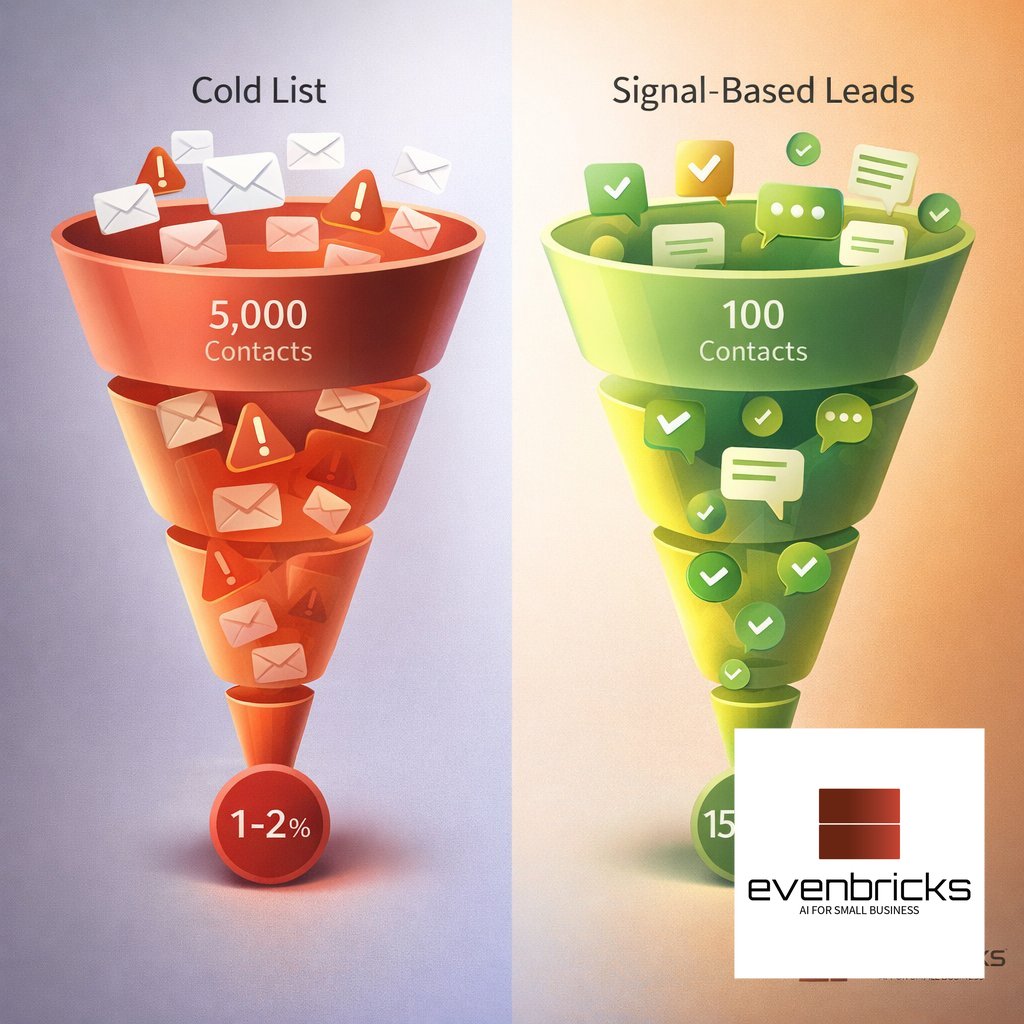
You just spent $2,000 on a list of 5,000 “qualified” restoration contacts. The vendor promised they’re all property managers, facility directors, and insurance adjusters in your area.
You load them into your CRM, fire off your best email sequence, and wait.
Three weeks later? Maybe 15 replies. Two angry unsubscribes. One booked call that no-showed. And now your email deliverability is tanking because half the addresses bounced.
Sound familiar?
Here’s the problem: you bought a list of names, not a pipeline of people actually looking for what you sell. And there’s a massive difference.
The Cold List Problem (And Why It’s Getting Worse)
Cold data lists have been a staple of B2B marketing for decades. The pitch is simple: buy a database of contacts matching your ideal customer profile, blast them with your message, and convert a percentage into customers.
Except the math doesn’t work anymore. Here’s why:
1. Conversion rates are abysmal
Cold lists typically convert at 1-5%, and that’s being generous. Most restoration and home services contractors see closer to 1-2% response rates, and far fewer than that actually turn into booked jobs.
Why? Because demographic data (job title, company size, location) tells you who someone is, not what they need right now. A property manager with 50 units might fit your ideal customer profile perfectly, but if they already have three restoration vendors on speed dial and aren’t actively looking for another, your email is just noise.
2. Deliverability and reputation damage
When you email thousands of people who never asked to hear from you, a few things happen:
- High bounce rates (outdated data is common)
- Spam complaints and unsubscribes
- Inbox providers like Gmail and Outlook start flagging your domain
- Your future emails, even to warm leads, end up in spam
One bad cold campaign can damage your sender reputation for months, hurting all your marketing efforts.
3. You’re competing with everyone else who bought the same list
That “exclusive” list of 5,000 contacts? It’s been sold to 47 other companies this quarter. Your target prospects are drowning in generic outreach from vendors all saying roughly the same thing.
Your message gets lost in the noise, no matter how good it is.
4. No behavioral context
A cold list tells you Sarah Johnson is a Facilities Manager at a 200-unit apartment complex in Phoenix. What it doesn’t tell you:
- Has she been searching for mold remediation services lately?
- Did she just download a guide on water damage prevention?
- Has she visited restoration company websites in the past two weeks?
- Is she actively comparing vendors right now?
Without that context, you’re guessing. And most of the time, you’re guessing wrong.
Signal-Based Lead Scoring: The Smarter Way
Now imagine a different approach.
Instead of buying a static list of names, you capture people while they’re actively searching for what you sell. Property managers googling “commercial water damage restoration near me.” Facility directors downloading whitepapers on mold prevention. Insurance adjusters visiting your pricing page.
These aren’t cold contacts. They’re warm-intent leads. And you can score them based on exactly how warm they are by tracking the signals they’re giving off.
How Signal Scoring Actually Works
Signal-based lead scoring assigns points to every action a prospect takes that indicates buying intent. The more signals, the hotter the lead.
Here’s how it typically breaks down:
Low-Intent (1-20 signals):
- Single website visit
- Opened one email
- Viewed a blog post
- Basic search for general information
Translation: They’re aware you exist, but they’re early in their research. Not ready to buy yet.
Medium-Intent (20-40 signals):
- Multiple page visits, especially service pages
- Downloaded a resource like a checklist, guide, or case study
- Searched for comparison keywords (“best restoration company in [city]”)
- Engaged with 2-3 emails
- Spent 5+ minutes on your website
Translation: They’re actively researching and comparing options. Getting warmer.
High-Intent (40-70+ signals):
- Visited your pricing or service area page multiple times
- Searched for competitor names or “restoration company reviews”
- Downloaded multiple resources
- Clicked on “Get a Quote” or “Contact Us”
- Returned to your site 3+ times in a week
- Engaged with email sequences and replied
- Visited from a commercial IP address during business hours
Translation: They’re in active buying mode. They need what you sell, and they’re deciding who to call. This is your moment.
The Performance Gap: Numbers Don’t Lie
Here’s the difference in real-world results:
Cold Lists:
- 1-5% reply rate
- 0.5-2% conversion to booked calls
- High unsubscribe and spam complaint rates
- Damaged sender reputation
- Long sales cycles, if they convert at all
High-Intent Signal-Scored Leads:
- 20-50% reply rate
- 15-30% conversion to booked calls
- Low unsubscribe rates (they actually want to hear from you)
- Improved deliverability from an engaged audience
- Shorter sales cycles because they’re already looking
That’s not a marginal improvement. That’s 2-3x better conversion on every metric that matters.
Why? Because you’re not interrupting strangers. You’re connecting with people who are already looking for what you sell.
Real-World Example: Restoration Company Case Study
Let’s look at how this played out for a Phoenix-based restoration contractor we’ll call Southwest Restoration.
The Old Way (Cold Lists):
- Bought a list of 3,000 property managers and facility directors
- Sent a 5-email sequence over 3 weeks
- Results: 47 replies (1.6%), 9 booked calls (0.3%), 1 closed job ($4,200)
- Cost: $2,000 for the list + $500 email tool + 15 hours of owner time = $3,000+ for one $4,200 job
- Bonus: email deliverability dropped 22%, hurting all future campaigns
The New Way (Signal-Scored High-Intent Leads):
- Captured 150 warm-intent leads over one month (people actively searching for restoration services)
- Segmented by signal score:
- 60 low-intent → nurture sequence
- 50 medium-intent → educational follow-up
- 40 high-intent → immediate personalized outreach
- Results from high-intent segment alone: 18 replies (45%), 10 booked calls (25%), 6 closed jobs (avg $5,800 = $34,800 revenue)
- Cost: $1,500 monthly for AI Prospect Engine system
- Owner time: 2 hours reviewing booked calls
The Bottom Line:
- 6x more revenue ($34,800 vs $4,200)
- 83x better conversion rate to booked calls (25% vs 0.3%)
- 90% less owner time
- Improved email reputation instead of a damaged one
And here’s the kicker: those 110 low- and medium-intent leads didn’t disappear. They went into automated nurture sequences, staying warm until they hit high-intent signals. Over the next 90 days, another 8 of them converted into booked jobs.
Cold lists give you one shot. Signal scoring gives you a pipeline that keeps working.
How to Actually Implement Signal Scoring (The Evenbricks Way)
You might be thinking: “This sounds great, but I don’t have time to track 70 different signals and manually score leads all day.”
You’re right. You don’t.
That’s where automation and AI come in. Here’s how a modern signal-scoring system actually works in practice:
Step 1: Define Your High-Intent Signals
Work with your marketing system or a platform like Evenbricks to identify which behaviors indicate buying intent for your business.
For restoration contractors, that typically includes:
- Searches for “[service type] near me” or “emergency restoration”
- Visits to pricing, service area, or emergency response pages
- Downloads of insurance guides or damage prevention resources
- Repeat visits within a short timeframe
- Engagement with educational email content
- Clicks on “Get Quote” or “Contact Us” buttons
Step 2: Capture and Score Automatically
Your AI backbone tracks every interaction across:
- Website visits (which pages, how long, how many times)
- Search behavior (what keywords brought them to you)
- Email engagement (opens, clicks, replies)
- Content downloads
- Form submissions
- Phone calls and texts
Each action adds to their signal score automatically. No manual tracking required.
Step 3: Segment by Score and Trigger Personalized Sequences
Once leads hit certain score thresholds, automated workflows kick in:
Low-Intent (1-20 signals):
- Add to educational nurture sequence
- Send helpful content like blog posts, prevention tips, and seasonal reminders
- Goal: stay top-of-mind until they need you
Medium-Intent (20-40 signals):
- More personalized outreach referencing their specific interests
- Case studies and testimonials relevant to their searches
- Soft call-to-action (“Want to chat about your specific situation?”)
High-Intent (40-70+ signals):
- Immediate notification to owner or sales team
- Personalized email or SMS within 5 minutes: “I saw you were looking at our [specific service]. I can help with that. When’s a good time to talk?”
- Phone follow-up within an hour
- Priority routing in your CRM
This is the “not a list, a pipeline” approach. Every lead gets the right message at the right time based on what they’re actually doing, not just who they are.
Step 4: Measure, Learn, Optimize
Your system tracks which signals correlate most strongly with closed jobs. Over time, it learns:
- Which score thresholds produce the best conversion rates
- Which messaging works best for each segment
- Which sources deliver the highest-quality leads
- When to follow up and how often
The AI backbone gets smarter every month, automatically fine-tuning your pipeline.
The Done-For-You Advantage
Here’s the reality: most restoration and home services contractors don’t have time to build and manage a sophisticated signal-scoring system from scratch.
You’re running job sites, managing crews, dealing with emergencies, and handling estimates. Somewhere in there you’re also supposed to become a marketing automation expert?
Not realistic.
That’s why the done-for-you approach wins. With a platform like Evenbricks, you get:
- Pre-built signal definitions tuned for restoration and construction businesses
- Automatic lead capture from search, web, email, and other channels
- AI-powered scoring that runs 24/7 in the background
- Ready-to-go sequences for each intent level
- CRM integration with tools you already use like ServiceTitan, Jobber, and HouseCall Pro
- A clear dashboard showing leads by score, conversion rates, and revenue impact
You focus on running jobs. The AI backbone handles the prospecting, scoring, nurturing, and booking.
All for a fraction of what it would cost to hire a marketing coordinator, with zero learning curve.
Stop Buying Lists. Start Building Pipelines.
The era of cold data lists is over. Buying someone else’s database and blasting generic messages doesn’t work anymore, and it’s actively hurting your business through damaged deliverability and wasted budget.
Signal-based lead scoring flips the model:
- Instead of interrupting strangers, you connect with people already looking
- Instead of one-size-fits-all blasts, you send personalized messages based on behavior
- Instead of hoping for 1-2% conversion, you hit 20-30% or better
- Instead of burning through lists, you build a pipeline that compounds over time
The businesses winning in restoration, construction, and home services aren’t the ones with the biggest marketing budgets or the fanciest websites.
They’re the ones who show up at the right time with the right message for people who are actually ready to buy.
That’s what signal scoring delivers. With the right AI backbone running it for you, the whole thing works on autopilot while you focus on what you do best: delivering quality work and growing your business.
Not a list, a pipeline. That’s the difference. And that’s why signal scoring wins.
Ready to stop losing deals to faster competitors with better lead intelligence? Evenbricks builds done-for-you AI marketing systems for restoration and home services contractors. We’ll prove we can generate qualified appointments using warm-intent data, and if it doesn’t hit the mark in the first 4-6 weeks, you keep the system. Learn how it works.